Butt Fusion Machine & Pipe Tool Manufacturer

Product Knowledge
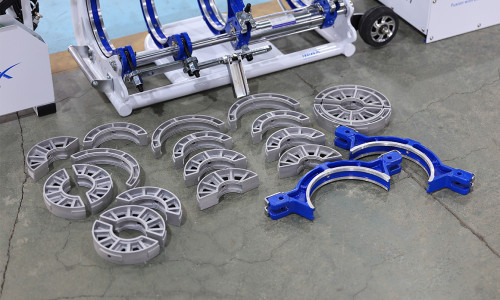
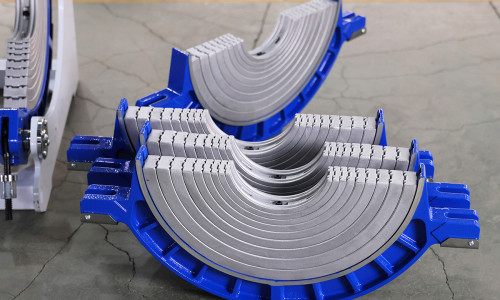
 Product Knowledge | How Clamp Insert Design Changes with Butt Fusion Machine SizeSep 22,2026This article explains why clamp insert design changes as butt fusion machine size increases, including differences in contact area, clamping stability, one-piece structures, widened inserts, and aluminum clamp design for large HDPE pipe welding.
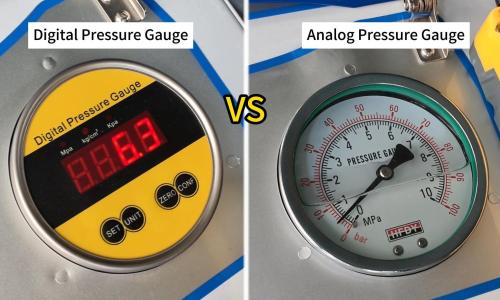
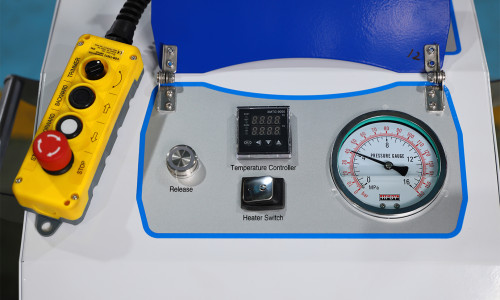
- Product Knowledge | FX Series: Digital vs. Analog Pressure GaugeSep 21,2026A quick comparison of the standard analog pressure gauge and optional digital pressure gauge used on FX Series hydraulic units, including their differences in readability, accuracy, and performance during a power failure.
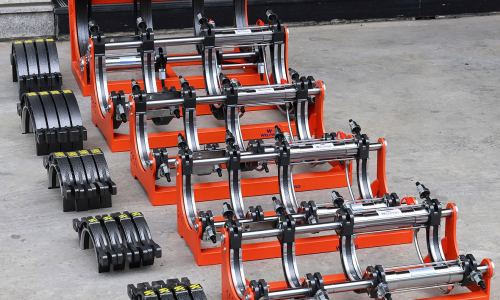
- Product Knowledge | Advantages of the Weipin Series B Butt Fusion Welding MachineSep 20,2026Welping B-series butt welding machines consist of the frame (including fixtures),facer, heating plate, lifting basket and tools.
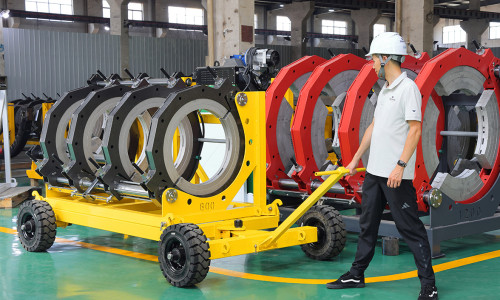
- Product Knowledge | What Should a Large-Diameter PE Pipe Fusion Machine Be Designed to Handle? A Closer Look at the WP800AAug 7,2026This article examines the key design requirements of a large-diameter PE pipe butt fusion machine, using the WP800A as a practical example. It covers frame rigidity, carriage guidance, clamping inserts, facing performance, heater temperature stability, hydraulic pressure control, equipment layout, site mobility and long-term maintenance.
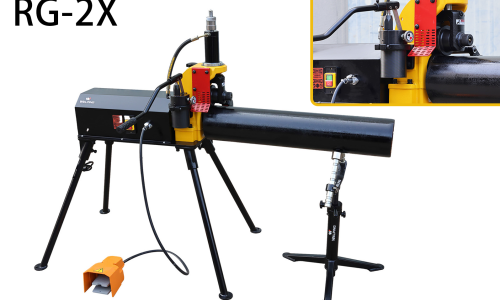
- Product Knowledge | How the RG-2X Ensures Stable Grooving for Medium to Large Diameter Steel PipesMay 9,2026The RG-2X roll grooving machine is designed for 2"–12" steel pipes, focusing on stable operation and practical usability. With support for SCH40 pipes up to 10 mm thickness and a fully sealed hydraulic system, it is suitable for fire protection, construction, and general piping applications. The machine provides a reliable solution for medium to large diameter pipe grooving.
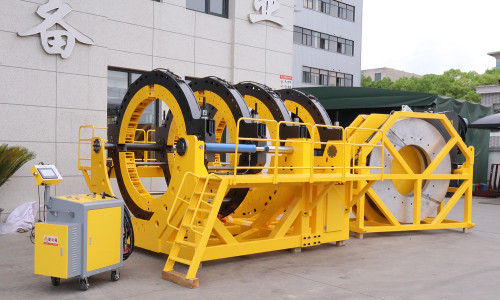
- Product Knowledge | Welping Custom 2000mm Butt Fusion Machine for Large-Diameter ApplicationsMar 25,2026A custom 2000mm butt fusion machine was developed by Welping for large-diameter pipeline applications. The design focuses on structural stability, consistent pressure control, and uniform heating performance under demanding conditions. Rather than a standard product, the machine reflects a project-based approach, addressing the practical challenges of ultra-large pipe welding.
- Product Knowledge | FX Series Remote Control: Built for Real Jobsite UseFeb 28,2026This article introduces the standard remote control used on FX series butt fusion machines. Designed for real jobsite conditions, the remote control features a clear four-button layout, emergency stop function, trimmer control, and magnetic mounting. It allows operators to work more flexibly, safely, and efficiently during on-site pipe alignment and welding operations.
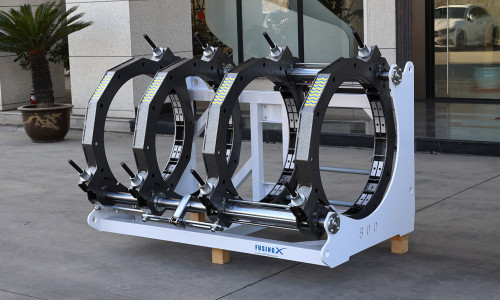
- Product Knowledge | FX Series Butt Fusion Machine Clamp ConfigurationFeb 13,2026This article explains how clamp configurations vary across FX series butt fusion machines based on pipe size. Models up to 315 typically use two to three clamp blocks, while machines sized 355 and above adopt a multi-segment full-circle clamp arrangement to provide more uniform contact and improved stability for larger and heavier pipes during alignment and welding.
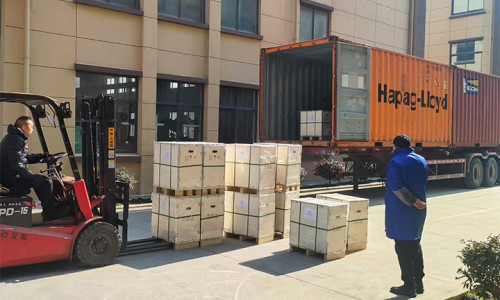
- Product Knowledge | Recent Shipment Update – Gruvmaster Roll Grooving MachinesFeb 4,2026A new batch of Gruvmaster roll grooving machines has completed assembly and shipment preparation. From final assembly to wooden crate packing, each machine is inspected and secured before delivery. These photos document the real manufacturing and shipping process, offering a transparent view of our production workflow and delivery standards.
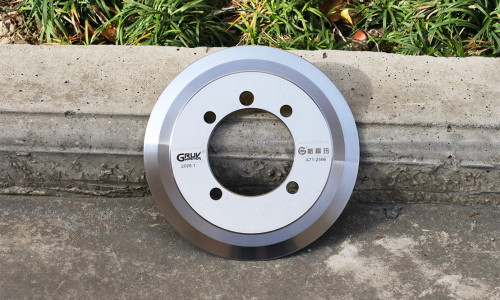
- Product Knowledge | A Practical Test and Usage Record of a Pipe Cutting BladeJan 28,2026This article documents a practical evaluation of a pipe cutting blade used on Gruvmaster pipe cutting machines. Based on repeated cutting tests under real steel and galvanized pipe conditions, the focus is on blade wear behavior, performance stability, usable service life, and compatibility across multiple machine models rather than single-cut performance data.
- Product Knowledge | FX Series Butt Fusion Machines: Practical Standard AccessoriesJan 10,2026This article explains the standard accessory configuration of FX series butt fusion machines. Beyond core components, the FX series includes practical accessories such as modular clamp inserts, accumulators, support shoes, and wear-resistant plates. Each standard accessory is selected based on repeated real job-site use, with additional reinforced configurations applied to larger models to support heavy-duty and large-diameter welding applications.
- Product Knowledge | Why the Frame Rings of FX800 and Larger Butt Fusion Machines Are Finished in BlackDec 31,2025FX800 and larger butt fusion machines use black-finished frame rings instead of standard blue due to material and manufacturing considerations. After high-temperature forging, the frame rings exhibit surface imperfections that would be more visible under a blue coating. A black finish helps achieve a more uniform and visually stable appearance suitable for large-scale welding equipment.
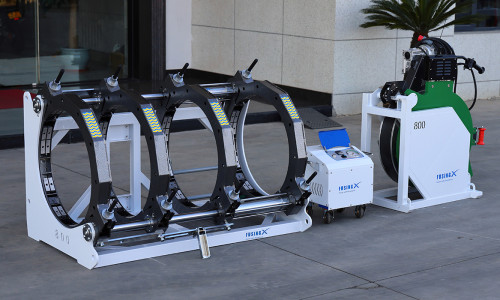
- Product Knowledge | What Makes Up a Complete Butt Fusion Welding Machine? FX630 as an ExampleDec 19,2025A complete butt fusion welding machine includes a main frame, facer, heater, and hydraulic power unit. Using the FX630 as an example, this article explains how each component works together during HDPE pipe welding, and why a lifting crane is offered as an optional accessory for large-diameter applications.
- Product Knowledge | Understanding the Frame Design of FX250 and FX315 in the FUSINGX FX SeriesDec 1,2025The FX250 and FX315 use a unique round-edge steel tube frame, while larger FX models adopt thickened steel plates. This article explains the structural differences and why each design fits its pipe size range, supported by real production photos.