

RG-2T Outward Groove Forming Process: How a Convex Groove Is Formed on Metal Pipe
In some pipe processing applications, a standard inward groove is not the only groove type required. Certain projects may call for an outward groove, also known as a convex groove, where the pipe wall is formed toward the outside rather than pressed inward.
This process is different from cutting or machining. No material is removed from the pipe. Instead, the groove is created through rolling pressure. As the pipe rotates, the forming roller gradually pushes the pipe wall outward and shapes the groove profile around the pipe.
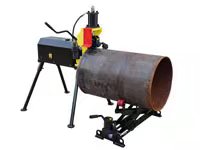
RG-2T is an inward and outward roll grooving machine designed for special groove forming applications. This article explains how RG-2T forms an outward groove and what happens during actual operation.
What Is an Outward Groove?
An outward groove is a groove profile formed outward from the pipe wall.
In a typical roll grooving process, the groove is pressed inward. Outward groove forming works in the opposite direction. The roller does not cut into the pipe surface. Instead, it applies controlled pressure to deform the pipe wall outward.
Simply put, an outward groove is not cut. It is formed by rolling.
During operation, the pipe rotates between the rollers. The forming roller applies pressure gradually, and the outward groove is shaped around the full circumference of the pipe.
How RG-2T Forms an Outward Groove
Outward groove forming relies on steady pipe rotation and controlled rolling pressure.
Before starting, the correct roller set should be installed according to the required groove type. The pipe is then positioned between the rollers, and the groove location is aligned.
When the machine starts, the pipe begins to rotate steadily. The operator gradually applies hydraulic feeding force, allowing the forming roller to press the pipe wall outward. As the pipe continues rotating, the groove profile is formed step by step.
Although the working principle is easy to understand, the final groove quality depends on several key factors, including the correct roller set, stable pipe rotation, smooth hydraulic feeding, and proper groove depth control.
RG-2T Outward Groove Forming Video
The video below shows the actual outward groove forming process with RG-2T.
In the video, the pipe keeps rotating while the forming roller gradually applies pressure. The outward groove is not completed in a single press. It is formed progressively through repeated rolling contact.
This operation video helps show how RG-2T works when an outward groove profile is required.
Key Features That Support Outward Groove Forming
Integrated Hydraulic Feed
Outward groove forming requires gradual and controlled pressure application. The integrated hydraulic feed structure allows the operator to apply pressure step by step during the forming process.
Adjustable Groove Depth
Different groove requirements may call for different forming depths. The groove depth adjustment structure helps the operator control the final groove profile according to the actual working requirement.
Gear Reduction Motor
Outward groove forming is a continuous rolling process, so stable pipe rotation is important. The gear reduction motor provides steady driving output to support consistent groove forming around the pipe.
Compact Structure
RG-2T features a compact machine structure, making it suitable for workshop use, small-batch processing, and special groove forming jobs where a large automatic grooving machine is not necessary.
Where Can This Process Be Used?
RG-2T is suitable for special groove forming work on metal pipes, especially aluminum pipes and stainless steel pipes that require an outward groove profile.
Outward groove forming is not required for every pipe project, but it can be useful when a special connection method or structural groove profile is needed. The actual forming result depends on the pipe material, wall thickness, roller set, and groove requirement.
For detailed working range, pipe material information, and machine configuration, please visit the product page:
【Add product page link here: RG-2T Inward & Outward Roll Grooving Machine】
Conclusion
Outward groove forming is a rolling process rather than a cutting process. The pipe wall is shaped outward by controlled pressure while the pipe rotates between the rollers.
RG-2T supports both inward and outward groove forming. For outward groove applications, stable pipe rotation, gradual hydraulic feeding, and the correct roller set are important for forming a consistent groove profile.
The operation video provides a clear view of how the outward groove is formed in real use, helping users better understand the working principle of RG-2T.