
How to Set the Heating Plate Temperature for PE100 and PE80 Pipe Butt Fusion Welding
In PE pipe butt fusion welding, the heating plate temperature is one of the key factors affecting weld quality. Many operators are used to setting the heating plate at 220°C. However, in actual field welding, PE100 and PE80 pipes should not always be treated in the same way.
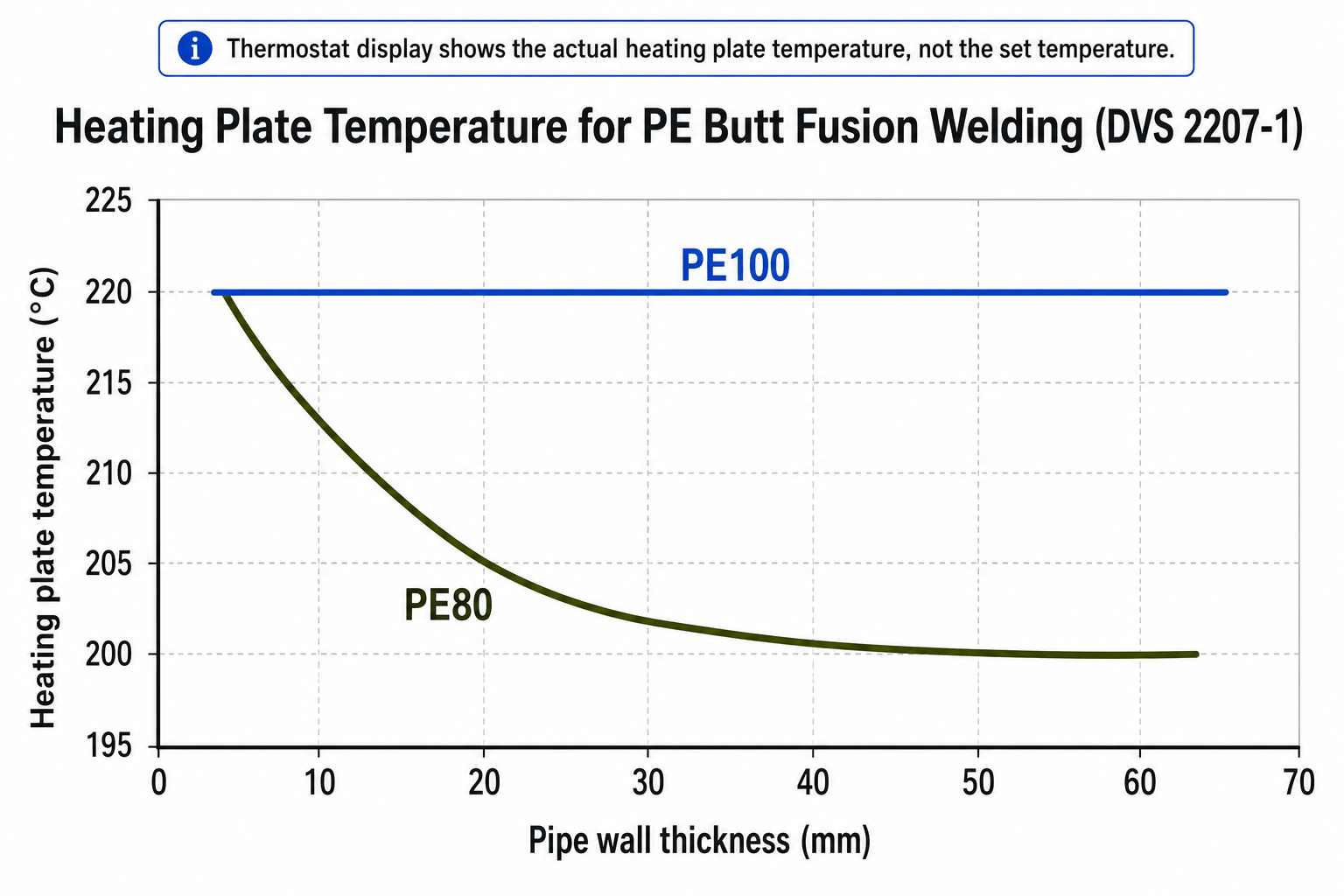
According to the general welding practice of DVS 2207-1 for PE-HD pipes, the heated tool temperature is usually selected within the range of 200–220°C. For pipes with smaller wall thickness, a higher temperature is normally used. For pipes with larger wall thickness, a lower temperature is generally preferred. For PE100 pipes, the upper part of this temperature range is commonly selected.
PE100 Pipes: Usually Around 220°C
For PE100 pipes, the heating plate temperature is normally set at around 220°C.
PE100 is a widely used high-performance polyethylene material for pressure piping systems. It offers good long-term strength and stable material performance. In the temperature recommendation curve based on DVS 2207-1, PE100 is generally shown at the upper temperature level, close to 220°C.
One important point should not be overlooked: the temperature shown on the thermostat display should reflect the actual heating plate temperature, not only the set value. Before welding, the operator should make sure the heating plate surface temperature has stabilized and remains within the required range.
PE80 Pipes: Temperature Depends on Wall Thickness
For PE80 pipes, the heating plate temperature should not be understood as a fixed 220°C setting. It should be selected according to the pipe wall thickness.
A simplified way to understand the temperature trend is:
| Pipe Material | Wall Thickness Condition | Suggested Heating Plate Temperature |
| PE80 | Thin-wall pipe | Close to 220°C |
| PE80 | Medium wall thickness | Around 205–215°C |
| PE80 | Thick-wall pipe | Close to 200°C |
PE100 | Most common wall thicknesses | Around 220°C |
This table is intended to explain the general principle. For formal welding work, the final welding parameters should still follow the project specification, the pipe manufacturer’s recommendations, and the applicable welding standard.
Why Does PE80 Require a Lower Temperature for Thicker Pipes?
A lower temperature for thick-wall PE80 pipes does not mean the pipe requires less heat. It means the pipe requires a more controlled and more uniform heating process.
For thick-wall PE80 pipes, heat needs more time to penetrate into the pipe wall. If the heating plate temperature is too high, the pipe end surface may become over-melted while the inner part of the wall has not been heated sufficiently. In serious cases, excessive surface temperature may also lead to material degradation or unstable bead formation.
That is why thick-wall PE80 pipes are usually welded with a lower heating plate temperature and a longer soaking time. This helps the pipe end form a more stable and uniform molten layer, reducing the risk of surface overheating and improving the reliability of the weld.
A simple way to understand it is:
Thin-wall pipe: higher temperature, shorter heating time.
Thick-wall pipe: lower temperature, longer soaking time.
Heating Plate Temperature Is Only One Part of the Welding Parameters
In butt fusion welding, temperature is important, but it is not the only factor that determines weld quality. A complete welding process also requires proper control of:
· Bead-up pressure
· Drag pressure
· Soaking time
· Changeover time
· Cooling time
· Pipe end facing quality
· Pipe alignment and misalignment control
· Heating plate surface cleanliness
Therefore, welding quality should not be judged by heating plate temperature alone. The correct welding parameters should be selected according to the pipe material, pipe diameter, wall thickness, and applicable welding standard.
Practical Recommendation
For PE100 pipes, the heating plate temperature is usually set at around 220°C.
For PE80 pipes, the temperature should be adjusted according to wall thickness. Thin-wall PE80 pipes can be heated close to 220°C, while thicker PE80 pipes normally require a lower temperature, gradually approaching around 200°C.
Operators should also check the actual heating plate surface temperature before welding, rather than relying only on the controller setting. The heating plate should be clean, stable, and ready before it is placed between the pipe ends.
Conclusion
PE100 and PE80 pipes require different considerations when selecting the heating plate temperature for butt fusion welding.
PE100 pipes are usually welded at around 220°C. For PE80 pipes, the temperature should be adjusted according to wall thickness: thin-wall pipes can be close to 220°C, while thick-wall pipes gradually decrease toward around 200°C.
The correct temperature setting is not about making the pipe end “as hot as possible.” It is about forming a proper, stable, and uniform molten layer. For thick-wall PE80 pipes, a lower heating plate temperature combined with a longer soaking time often provides a more reliable welding result than simply increasing the temperature.