

Technical Guide | HDPE Butt Fusion Pressure Explained: From Bead-Up to Cooling
Why does pressure rise, drop, and then rise again during HDPE butt fusion? Each change serves a purpose. First, the machine presses the pipe ends against the heater plate to form a bead. Then it reduces pressure so the pipe ends can continue to absorb heat. Once the heater plate is removed, the machine brings the heated ends together and holds them under pressure as the joint cools.
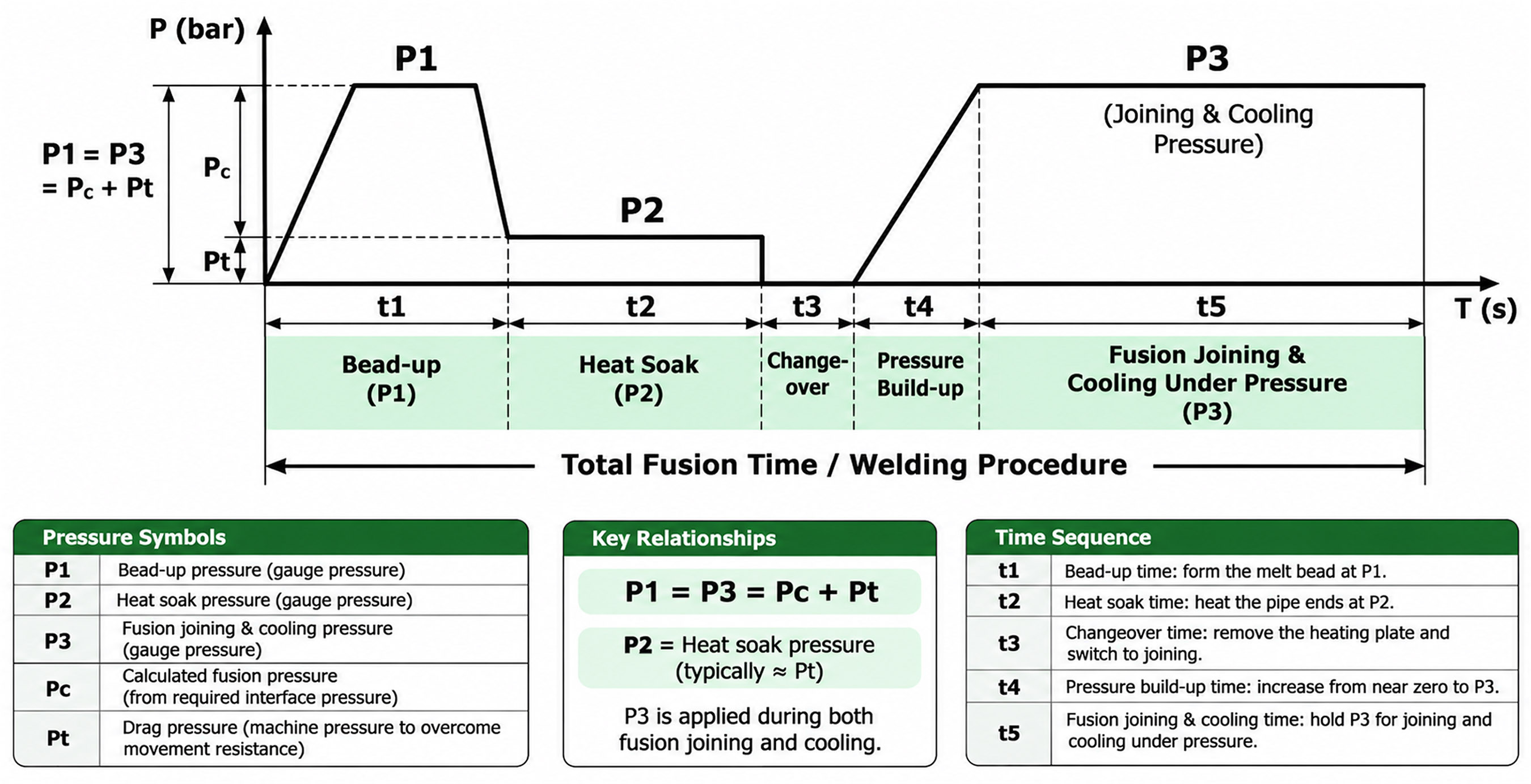
The diagram illustrates the ISO 21307 single low-pressure (SLP) procedure. The vertical axis shows the machine’s hydraulic gauge pressure, and the horizontal axis shows time.
Reading the Curve from Left to Right
| Stage | What happens | ||
| t1 — Bead-up (P1) | The machine presses both pipe ends against the heater plate until a bead of the required size forms around each end. | ||
| t2 — Heat soak (P2) | The pressure is reduced while the pipe ends stay in contact with the heater plate, allowing heat to penetrate farther into the pipe wall. | ||
| t3 — Changeover | The carriage opens so the heater plate can be removed. | ||
t4 — Pressure build-up | The heated pipe ends are brought together, and the pressure rises to the target joining pressure, P3. | ||
t5 — In-machine cooling under pressure (P3) | The machine holds the joint at P3 until the in-machine cooling period is complete. | ||
Why Is Drag Pressure Added During Bead-Up and Joining?
Part of the pressure shown on the gauge is needed just to move the carriage and the pipe it holds. That portion is called drag pressure (Pt).
The machine also needs to generate the force required at the pipe ends. The hydraulic pressure needed to produce that force is Pc. It is calculated from the required interfacial pressure, the cross-sectional area of the pipe wall, and the effective area of the machine’s hydraulic cylinders.
In the single low-pressure procedure shown here, bead-up and joining use the same target gauge pressure. Both include the calculated hydraulic pressure and the measured drag pressure.
P1 = P3 = Pc + Pt
Why Can Heat Soak Pressure Be Lower Than Drag Pressure?
When you measure drag pressure, the machine has to move the carriage and the clamped pipe. During heat soak, the pipe ends are already resting against the heater plate. All the machine has to do is keep them in contact.
ISO 21307’s single low-pressure procedure calls for the lowest pressure that maintains contact with the heater plate, up to the current drag pressure. The diagram shows P2 close to Pt as an illustration. During an actual weld, P2 can be lower.
If you see the gauge reading rise briefly at the start of heat soak and then settle, it’s worth noting when it happens and under what conditions. What do you typically see on your machine during heat soak? If you’ve recorded a pressure curve, share the machine model, pipe diameter, and SDR so we can compare observations across different setups.